
How to Write Compelling Email Subject Lines
The First Impression That Gets the Click (and Doesn’t Land in Spam)
Crafting the perfect email subject line is like writing the headline for your brand’s personal billboard—except it’s only visible for a few seconds in a crowded inbox.
The subject line is the first impression, the handshake, the teaser trailer. If it doesn’t work, your amazing email never gets opened, never gets read, never gets results.
So if your open rates feel like they’re ghosting you, this guide is your lifeline. We’re diving into the art and science of writing subject lines that actually get clicked—without clickbait or cringe.
Let’s unlock your subject line superpower.
Why Subject Lines Matter (More Than You Think)
Subject lines are the gatekeepers to your message.
In a world where people check their email on the go, during meetings, or while multitasking at stoplights (guilty), your subject line needs to grab attention in 3 seconds or less.
Here’s why they matter:
-
They directly affect open rates
-
They impact deliverability (yes, spam filters are watching)
-
They set expectations for the email content
-
They build (or break) trust over time
A weak subject line equals a wasted email. But a strong one? It can skyrocket engagement and conversions.
Rule #1: Write for Humans, Not Algorithms
Yes, algorithms matter. But humans open emails, not bots.
Your subject line should:
-
Spark curiosity
-
Promise value
-
Evoke emotion
-
Be relevant to the reader
Instead of thinking, how do I trick someone into opening this? ask, how do I intrigue or serve the person on the other side?
The Anatomy of a Great Subject Line
A compelling subject line usually has one (or more) of these elements:
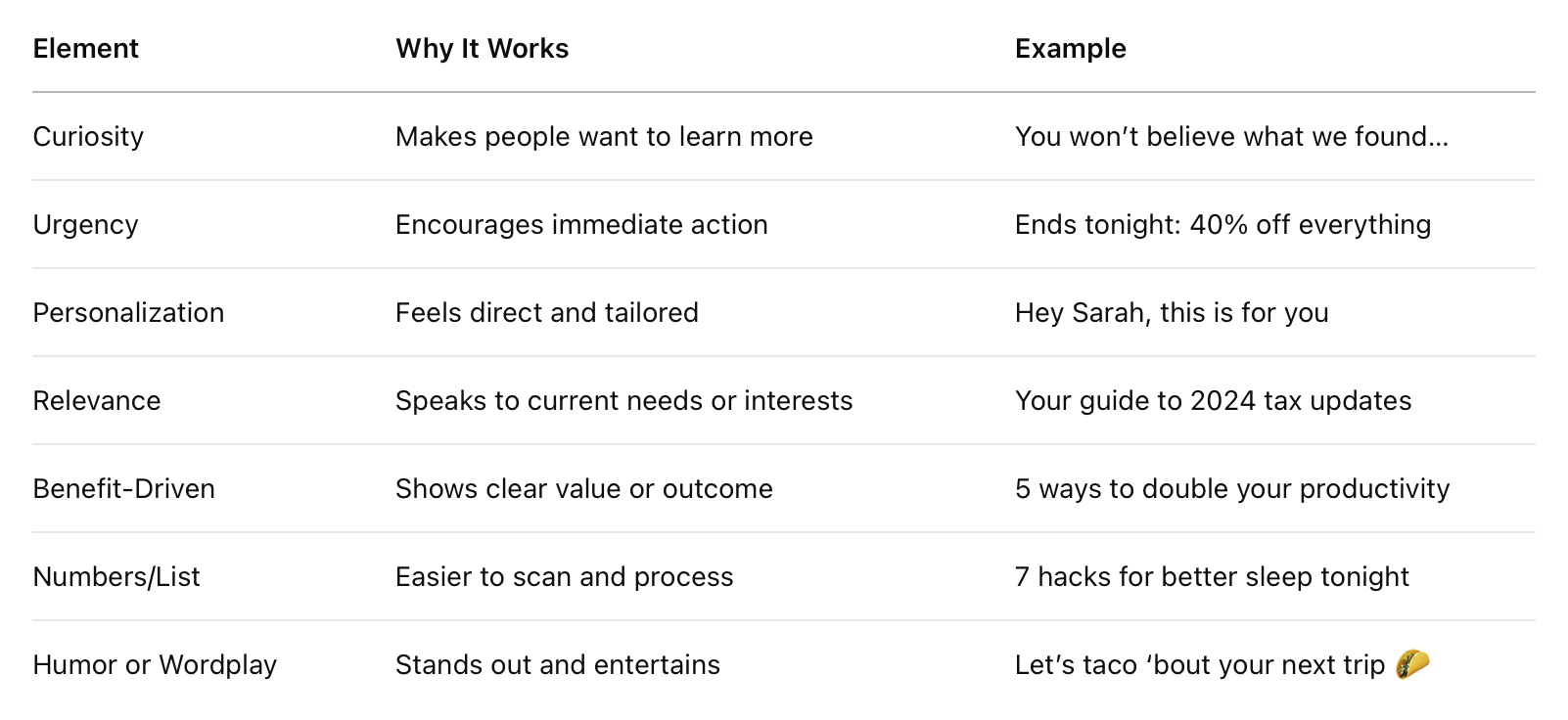
Don’t try to cram them all into one line—pick the one that fits your message best.
Rule #2: Keep It Short, Punchy, and Scannable
The golden length? 6–10 words or around 40–60 characters.
Mobile devices truncate longer subject lines, so front-load the most important words. Example:
Bad: Here’s a limited-time offer you won’t want to miss
Better: Limited-time offer: 40% off today only
Bonus tip: Use sentence case or all lowercase if it fits your brand tone. IT’S NOT ALWAYS COOL TO SHOUT IN CAPS.
Rule #3: Avoid Spam Trigger Words
Even the most clever subject line means nothing if it’s caught in spam filters.
Common spam trigger words to avoid:
-
Free!!!
-
Risk-free
-
Urgent
-
Make money
-
Earn cash fast
-
Congratulations
-
Winner
-
Act now!
Instead, use natural language. Think conversational, not commercial.
Rule #4: Use Personalization (But Don’t Be Creepy)
Emails with personalized subject lines see a 26% boost in open rates (Campaign Monitor).
Ways to personalize:
-
First name
-
Location
-
Purchase behavior
-
Content preferences
Examples:
-
Sam, we picked this just for you
-
Your Denver guide to outdoor fun
-
Back in stock: That jacket you loved
But don’t overdo it—nobody wants to feel like their inbox is being stalked.
Rule #5: Test. Tweak. Repeat.
Even experts don’t get it right on the first try. That’s why A/B testing is your best friend.
Test subject line variables like:
-
Emojis vs. no emojis
-
Questions vs. statements
-
First-person vs. third-person tone
-
Curiosity vs. clarity
-
Short vs. long
Over time, your audience will tell you what they like—through clicks and opens. Listen to the data.
Subject Line Formulas That Work
Here are some fill-in-the-blank formulas you can adapt instantly:
Curiosity-Based:
-
What no one tells you about [topic]
-
The truth about [common belief]
-
Can we be honest about [topic]?
Benefit-Focused:
-
How to [achieve result] without [obstacle]
-
The easiest way to [desired outcome]
-
[Number] ways to [goal] this week
Question-Driven:
-
Are you making this mistake with [topic]?
-
Ready to upgrade your [skill/tool]?
-
Want to save 20 minutes a day?
Urgency-Based:
-
⏳ Only 12 hours left…
-
Your cart is about to expire
-
Final chance to claim your bonus
Conversational & Fun:
-
Oops… did you forget this?
-
Let’s fix that (fast)
-
Well, this is awkward 😬
Save these in a swipe file—you’ll never stare at a blinking cursor again.
Should You Use Emojis?
Short answer: Yes, but carefully.
Emojis can:
-
Help your email stand out in the inbox
-
Convey tone or context
-
Replace words in a clever way
Best practices:
-
Stick to 1–2 max
-
Make sure they render properly on all devices
-
Use emojis relevant to the content (no random 🐙 unless you’re selling octopus gear)
Example:
Subject: 🎯 Master your morning routine in 3 steps
Preview Text: The Unsung Hero
Don’t forget the preview text—the snippet that shows up next to your subject line.
If your subject line is the movie title, your preview text is the trailer. Use it to:
-
Expand on the promise
-
Add more curiosity
-
Support your CTA
Example:
Subject: Your free guide is inside
Preview: Download our 10-step checklist to boost engagement today.
Common Mistakes to Avoid
Here’s what not to do:
-
Bait and switch: Your subject line promises one thing, but the email delivers something else. (Instant unsubscribe.)
-
Too vague: Subject lines like Quick update or Newsletter #15 add zero value.
-
Overused tactics: Everyone’s doing FOMO and emojis now—make sure it fits your brand.
-
Too clever: If people have to decode your meaning, you’ve already lost them.
Stay clear. Stay true. Stay useful.
Final Thoughts: Your Subject Line Is the Invite to the Party
Think of your subject line like this: you’re throwing a party (aka, your email), and the subject line is the invitation. It needs to:
-
Stand out
-
Be intriguing
-
Set expectations
-
Convince the right people to RSVP
Every email is a new opportunity to show your audience that you respect their attention—and that what’s inside is worth their time.
So don’t phone it in. Don’t overthink it either. Be real, be valuable, and test until you find what works for your audience.
Because in a crowded inbox, clarity beats cleverness. And relevance always wins.